Showing posts with label consulting. Show all posts

Wednesday, June 11, 2014

Meditation Techniques for Concentration

Meditation is mainly done for the purpose of relaxation of mind and for gaining good concentration as well. Your level of concentration is sure to be improved if meditation is done on a regular basis.

In the beginning you may feel distracted. But it is very necessary that you have a good focus so that you improve. There are many meditation techniques for concentration that can be implemented.

Focusing on a particular object is very essential to develop concentration. This has to be done for a certain time. Depending on this the techniques for concentration can be mainly divided into 3 types. They are Zazen, which is mainly breathing concentration, Vipassana, which is also known as concentrate to sensations and Tratak, which is also known as concentrate to candle flame.

Zazen

This is a very renowned Buddhist practice of developing concentration and an effective meditation technique.

This technique of meditation is known to be the best for beginners. This helps in focusing on breathing while you count.

The seating posture for this purpose should be such that your spine is erect when you do this form of meditation.

Vipassana

This technique of meditation is also the best for beginners. The physical sensations of body are focus when you do this.

It is known to have enlightened many people when compared to any other technique of meditation. It helps in keeping your mind very cool and you can also control your mind in a very easily.

Tratak

This is known to be a wonderful technique of meditation that helps in providing you with the desired results. It helps you to keeping your mind focused and also greatly assists in enhancing memory as well.

In this technique, candle flame is focused and concentrated. It helps you to come out of distractive thoughts. 


Tuesday, June 10, 2014

Meditation and Breathing Exercises to Reduce Stress


How you react to stress determines how it will affect you. Too much stress can be bad for your heart. Learn how to manage your stress with deep breathing and meditation exercises.

Stress can be hard to avoid, but don’t worry if you can’t avoid stress completely—you don’t have to.stress is a normal physical and psychological to both positive and negative situations. Stress itself isn’t necessarily unhealthy—but your reaction to it can be.

How Does Stress Affect Your Heart?

When stress becomes constant and chronic, it can cause an increase in heart rate and blood pressure that may damage the artery walls, the American Heart Association (AHA) reports. Stress that’s left unchecked may contribute to high blood pressure, heart disease, obesity, and diabetes.
In particular, research has shown that those with “Type A” traits—such as often feeling rushed, irritated, impatient, or angry—have an increased likelihood of developing heart disease. Emotions like anger and hostility cause your body to release stress hormones into your blood. This causes an increase in your heart rate and blood pressure, which makes your heart work harder.

Managing Your Stress Levels

Although the exact link between heart disease and stress is unclear, it’s smart to take steps now to get your stress levels under control. It may be tempting to ask your doctor for medicine to manage stress, but lifestyle changes such as stress management techniques are a much better long-term strategy to lower your stress level.

One of the best ways to help you relax and manage stress is through deep breathing exercises, including meditation. It takes a little practice to make a habit of breathing exercises, but anyone can learn them. You can use them at home or in the office—or anywhere that you need some relief. Try these exercises, recommended by the AHA and Mayo Clinic, to help reduce stress:


Friday, January 31, 2014

Tips for Juniors Who Want to Play College Golf


Playing college golf can be a wonderful experience and is the goal of many junior golfers. The biggest challenge for the average junior golfer is deciding where he or she fits into the college golf picture.

One thing that is consistent for any high school player is the importance of a good golf resume. Your resume will give a college coach an accurate account of your golfing and academic record. The following are a few tips on how to put together a strong resume and how to get that resume into the hands of college golf coaches.

Preparing Your Resume
Your resume begins with the basics. The vital information should include:

• Name
• Address
• Telephone
• Birth date
• Social Security Number
• Height
• Weight
• Name of High School
• Month and Year of Graduation
• Grade Point Average/Class Rank
• SAT or ACT Scores
• USGA or State Handicap Index
• High School Stroke Average
• List Other Sports and Extracurricular activities

Next is the most important part. You need to list your tournament results and highlights. These scores are much more important than a handicap from your home club. Remember to list:

• Event name and location
• Number of players in the field
• Your finish
• Course rating and distance
• Unusual weather for the event
• Yardage for the course

This part of the resume is where you show a college coach how well you play tournament golf. You may want to break this down by year, so coaches can see improvement from year to year.

Along with a cover letter, this resume will be sent to college coaches.

Many high school players also send video to coaches. If you can get taped, this is a good idea. Remember to use a VHS tape with good quality (or burn a CD/DVD). 


What Happens to the Brain When You Meditate (And How it Benefits You)


What is Meditation?

There are different ways to meditate, and since it’s such a personal practice there are probably more than any of us know about. There are a couple that are usually focused on heavily in scientific research, though. These are focused-attention, or mindful meditation, which is where you focus on one specific thing—it could be your breathing, a sensation in your body or a particular object outside of you. The point of this type of meditation is to focus strongly on one point and continually bring your attention back to that focal point when it wanders.

The other type of meditation that’s often used in research is open-monitoring meditation. This is where you pay attention to all of the things happening around you—you simply notice everything without reacting.

What Happens in Your Brain When You Meditate

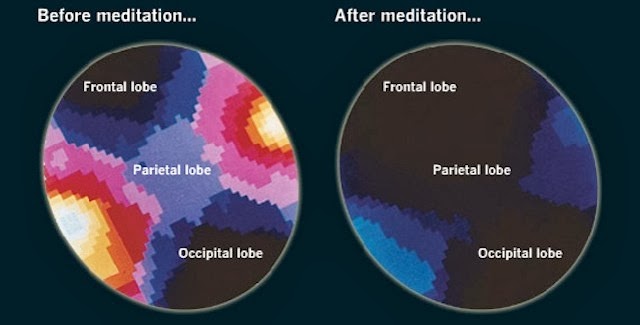
This is where things get really interesting. Using modern technology like fMRI scans, scientists have developed a more thorough understanding of what’s taking place in our brains when we meditate. The overall difference is that our brains stop processing information as actively as they normally would. We start to show a decrease in beta waves, which indicate that our brains are processing information, even after a single 20-minute meditation session if we’ve never tried it before.

In the image below you can see how the beta waves (shown in bright colors on the left) are dramatically reduced during meditation (on the right).


Below is the best explanation I found of what happens in each part of the brain during meditation:

Frontal lobe
This is the most highly evolved part of the brain, responsible for reasoning, planning, emotions and self-conscious awareness. During meditation, the frontal cortex tends to go offline.

Parietal lobe
This part of the brain processes sensory information about the surrounding world, orienting you in time and space. During meditation, activity in the parietal lobe slows down.


Simple Safety Guidelines for Golfers


Golf is a very safe sport - as long as a few basic, common-sense rules of safety are followed. When those rules are ignored, injuries can occur.

Golf involves the swinging of metal clubs, which propel golf balls at high speeds. If you're in the way of either the clubs or the balls, you're in danger. You could be placing yourself in danger, too, if you do not respect the power of the sun, the danger of lightning, or your body's need for the right kind of fluids on warm days.

Keep Track of Those Around You
When a golf club is in your hands and you are preparing to swing, it is your responsibility to make sure your playing partners are a safe distance away from you. It's not too difficult, after all, to keep track of where everyone is when your group is likely just four or fewer golfers.

Never swing a golf club when another golfer is close to you. That's the most important thing to remember. And be a little extra cautious on practice swings, when it's easy for golfers to let their guard down. Extra vigilance is also needed when younger golfers are part of your group.

Also, look ahead of you, and to the left and right of the area where you are aiming your shot. Don't hit your ball until you are confident that any golfers up ahead are out of your range.

Heads Up
While it's the responsibility of every golfer to be sure it is safe for them to take their stroke, you can't always rely on every golfer to do just that. So even when it's not your turn to hit, stay aware of your surroundings.

Be especially careful if you have to venture into an adjoining fairway to retrieve or play an errant shot, or if you are close to an adjoining fairway and golfers on that hole are hitting toward you.


Wednesday, January 22, 2014

Zen Meditation Techniques for Men


Meditation is among the most preached of relaxation methods,

often recommended for getting rid of our anxieties and alleviating pain or suffering. However, meditation isn't the simplest of things to practice or gain perfection over, since it requires maintaining absolute focus. Yes, the benefits are immense with greater concentration, lesser anxiety and an overall feeling of wellness. Zen Meditation works upon the principle of gaining enlightenment which essentially means you are elevated to a level where your mind is free from the usual clutter of disturbing ideas. When you are in the Zen Meditation state, you are passing into a state of self-reflection & introspection that helps to create a mind and body synergy.

The difficulties of mastering the art of Zen meditation often makes people quit this rather helpful lifestyle habit. The objective of this article is to help you gain a certain degree of control over Zen Meditation. These tips are easy to understand and follow:

• Set aside a specific time during which you plan to meditate. Just like your body follows a sleeping regimen, your mind will gradually become accustomed to the idea of meditating or concentrating, every day.

• Before trying to focus your mind, try to slow your breathing pattern. Unless, the breathing in under control, you won’t be able to concentrate. Unless, a slower breathing pattern is adopted, your muscles won’t be able to relax. This is the only way to regulate your circulation also so that you don’t sweat too much or feel thirsty and irritated.

• It is better to do some basic stretching before you get seated for your meditation. This helps to loosen the tendons and muscles. This aids better circulation of blood. These factors help to be seated in the same position without feeling bodily pain or discomfort.

10 Little Habits that Steal Your Happiness


You ultimately become what you repeatedly do.  If your habits aren’t helping you, they’re hurting you.  Here are a few examples of the latter that will steal your happiness if you let them:


1.  Focusing on everyone’s story except your own.

Don’t be so satisfied with the success stories of others and how things have gone for them that you forget to write your own.  Unfold your own tale and bring it to life.  You have everything you need to become what you are capable of becoming.  Incredible change happens when you decide to take control.  This means consuming less and creating more.  It means refusing to let others do your thinking, talking, and deciding for you.  It means learning to respect and use your own ideas and instincts to write your passage.

If you want your life story to soar to new heights, you’ve got to clear a path, reduce the time-sinks and burdens weighing you down, and pick up the things that give you wings.  Keep your best wishes and your biggest goals close to your heart and dedicate time to them every day.  If you truly care about what you do and you work diligently at it, there’s almost nothing you can’t accomplish.

2.  Waiting for the perfect moment.

Don’t buy into the myth of the perfect moment.  Moments aren’t perfect; they’re what you make them.  So many people wait around for the stars to align to do what they’re here to do.  The perfect moment, the perfect opportunity, the perfect state of being, etc.  Wake up!  These states of perfection are myths.  They do not exist.

Your ability to grow to your highest potential is directly related to your willingness to act in the face of imperfection.  You will come to succeed not by finding a perfect moment, but by learning to see and use life’s imperfections perfectly.  Read The Power of Now.