Showing posts with label visionary. Show all posts

Tuesday, June 10, 2014

Meditation and Breathing Exercises to Reduce Stress


How you react to stress determines how it will affect you. Too much stress can be bad for your heart. Learn how to manage your stress with deep breathing and meditation exercises.

Stress can be hard to avoid, but don’t worry if you can’t avoid stress completely—you don’t have to.stress is a normal physical and psychological to both positive and negative situations. Stress itself isn’t necessarily unhealthy—but your reaction to it can be.

How Does Stress Affect Your Heart?

When stress becomes constant and chronic, it can cause an increase in heart rate and blood pressure that may damage the artery walls, the American Heart Association (AHA) reports. Stress that’s left unchecked may contribute to high blood pressure, heart disease, obesity, and diabetes.
In particular, research has shown that those with “Type A” traits—such as often feeling rushed, irritated, impatient, or angry—have an increased likelihood of developing heart disease. Emotions like anger and hostility cause your body to release stress hormones into your blood. This causes an increase in your heart rate and blood pressure, which makes your heart work harder.

Managing Your Stress Levels

Although the exact link between heart disease and stress is unclear, it’s smart to take steps now to get your stress levels under control. It may be tempting to ask your doctor for medicine to manage stress, but lifestyle changes such as stress management techniques are a much better long-term strategy to lower your stress level.

One of the best ways to help you relax and manage stress is through deep breathing exercises, including meditation. It takes a little practice to make a habit of breathing exercises, but anyone can learn them. You can use them at home or in the office—or anywhere that you need some relief. Try these exercises, recommended by the AHA and Mayo Clinic, to help reduce stress:


Monday, June 9, 2014

Tips For Successful Meditation That Can Make You Happier

Meditation actually can make physical changes to your brain wiring and increase function. Using meditation as part of your daily routine will help to reorganize your thinking
A routine involving meditation may be one of the most effective ways to keep your life in balance. Meditation is a proven way of lowering stress, reducing anxiety, relieving depression, and increasing health. Meditation has been shown to improve cognitive functioning, heart health, defense mechanisms functioning, and digestion.

As a matter of fact, meditation can be quite simple should you follow a few tried and true strategies for successful meditation. Each time you meditate you will learn something new about yourself.

Wear Comfortable Clothing

You will need to wear something that is not binding and won’t be distracting. Loose fitting clothes that will permit your body to move and breathe freely are preferred. Loose fitting organic cotton works perfectly.

Find Quiet

Meditation brings energy into us. So it’s necessary thing for meditation to get it done in pin drop silence. Just turn of the all gadgets even your mobile too. Turn off radio, TV, Laptop etc.They might interrupt you during meditation.

Sit Comfortably

In comparison with what many believe meditation isn’t about sitting in an uncomfortable position for some time. Sit comfortably but try the recommended positions, like the lotus, since they are designed to minimize body ache and optimize what you can do to breathe correctly.

Loosen Up

Its little weird to relax, you can scrunch up your hands for your ears and then slowly allow them to fall down. Sometime it helps to help you stress less magically. You are able to relax your body by loosen your cheeks, mouth, arms and shoulders.

Focus on Your Breathing

The important thing to any meditation practice is concentrating on the breath. Controlled breathing stabilizes blood pressure level and increases oxygen flow, thereby increasing alertness. Stay silent and concentrate. 

Friday, January 31, 2014

What Happens to the Brain When You Meditate (And How it Benefits You)


What is Meditation?

There are different ways to meditate, and since it’s such a personal practice there are probably more than any of us know about. There are a couple that are usually focused on heavily in scientific research, though. These are focused-attention, or mindful meditation, which is where you focus on one specific thing—it could be your breathing, a sensation in your body or a particular object outside of you. The point of this type of meditation is to focus strongly on one point and continually bring your attention back to that focal point when it wanders.

The other type of meditation that’s often used in research is open-monitoring meditation. This is where you pay attention to all of the things happening around you—you simply notice everything without reacting.

What Happens in Your Brain When You Meditate

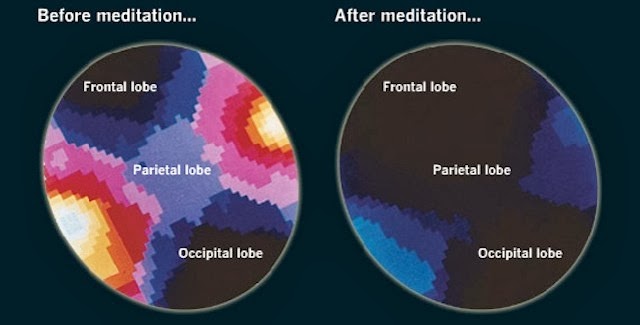
This is where things get really interesting. Using modern technology like fMRI scans, scientists have developed a more thorough understanding of what’s taking place in our brains when we meditate. The overall difference is that our brains stop processing information as actively as they normally would. We start to show a decrease in beta waves, which indicate that our brains are processing information, even after a single 20-minute meditation session if we’ve never tried it before.

In the image below you can see how the beta waves (shown in bright colors on the left) are dramatically reduced during meditation (on the right).


Below is the best explanation I found of what happens in each part of the brain during meditation:

Frontal lobe
This is the most highly evolved part of the brain, responsible for reasoning, planning, emotions and self-conscious awareness. During meditation, the frontal cortex tends to go offline.

Parietal lobe
This part of the brain processes sensory information about the surrounding world, orienting you in time and space. During meditation, activity in the parietal lobe slows down.


Wednesday, August 7, 2013

Golf Driver Swing: How to Stop Slicing


To have the ability to drive the golf ball straight using your driver from the tee box is really important, simply because it will set the tone for the whole hole you're on. A perfect golf driver swing may improve your probability to score a "Birdie" or perhaps may also find yourself in a large mess if you slice the ball into the rough or perhaps out of bounds. Slicing the ball is primarily a problem with all levels of golfers, ranging from an amateur to a pro. Slicing depends upon the particular kinematics of the shot. The rotational movement of the ball imparts a force making the ball to curve to left or right in midair creating slicing.

Though it is among the major issues that lots of golfers have, it can be resolved through continual practice in addition to perfected techniques. Below are a few tips which can be employed to avoid slicing while you take the all-important golf driver swing.

1. Griping The Golf club

Grip the golf club by positioning the left thumb in line with the shaft of the golf club, and curl the other fingers around the shaft making sure that they are aiming toward your right eye. Grip the club firmly and when you have the club in position, the first three knuckles of your left hand ought to be visible. Your forefinger and thumb should really create a 'V' formation that's acute enough so the forefinger points to the right shoulder. This type of golf grip is known as a strong golf grip, and it's extremely important to have a strong grip instead of a weak or a neutral golf grip to prevent slicing the ball.


6 Simple Tips To Cure The “Over The Top Golf Swing”


Do you swing “over the top? If you don’t know what it is, it is a move that is common among the majority of amateur golfers, and the result is usually a slice or a dead pull depending on your clubface position at impact.

The Over The Top Golf Swing The over the top golf swing is a premature movement of the upper body before the lower body in the downswing. The upper body actually gets ahead of the lower body causing an “outside to in” golf swing. This path is the least desirable in golf.

Take a look at the picture and you get a real clear idea of what’s happening in a correct golf swing and an incorrect one. Look at the top (incorrect) one. The golfers has pulled his club what too far inside on the take-away, and how to compensate by coming over the top in the downswing

There are many causes of this swing fault, some of which are physical and can be easily corrected, and some that are mechanical and with the right swing thoughts can be fixed.

1) Drop your arms. I used to swing over the top years ago, and I tried everything to correct it, including lessons with no success. Then I was watching one of my taped videos of Nick Price and saw how his arms seemed to drop in place in the downswing.

I ran to the range and tried it. My first move from the top of my swing was a dropping of my arms, the rotating. It worked! I couldn’t believe it! I just cured that dreaded swing fault with one swing thought. Give it a try!

2) Rotate down. Here’s another swing thought I’ve used if this swing fault creeps into my swing during a round. I think of rotating down to the ball. Not out! Down. I maintain my spine angle, so I’m not literally dropping down, but I focus on rotating through that golf ball.

10 Power Tips for Women


Looking to gain a few yards off the tee? Consider these helpful tips.

Swing around your body
 
When you're taking your practice swings on the tee, swing the clubhead several inches off the ground. This encourages you to swing more around your body (rather than up and down), which will help increase your clubhead speed and add distance. And when you're at the range, spend more time with your driver and woods than the rest of the long clubs in your bag. You'll be hitting these clubs more frequently than your 5- or 6-iron, so give them a good workout.

Give yourself room to rip it

Set up with a wide stance, ball forward, weight on your right side and a tilt in your shoulders (your head should be to the right of your pants zipper). Then hold the driver far enough away from your body to allow for a big, powerful swing. My rule is that the butt end of the club should be at an open-hand's distance from your body.

Resist with the hips

A major source of power is the winding of the upper body against the resistance of the lower body. The more you turn your shoulders relative to your hips, the more momentum you create for the downswing. The hips unwind naturally and the shoulders follow, generating power through the hitting area, like a slingshot. To help feel the separation between your upper and lower body, turn your right toe in at address about 20 degrees, and swing. This will prevent your right hip from turning too much on the backswing.

Swing through, not to, the ball

Most slow-swinging amateurs slap at the ball or try to scoop it up into the air, which causes the clubhead to slow down through impact. There's no gradual buildup of speed, which is a defining trait of good tempo. To learn how to accelerate the club through impact to a full, balanced finish, practice swinging with your headcover on your driver. The additional resistance on the clubhead will force you to drive it through impact into a full finish, and will teach you how to use tempo to generate more speed and power.

Zazen Instructions

Zazen is the form of meditation at the very heart of Zen practice. In fact, Zen is known as the “meditation school” of Buddhism. Basically, zazen is the study of the self. The great Master Dogen said, “To study the Buddha Way is to study the self, to study the self is to forget the self, and to forget the self is to be enlightened by the ten thousand things.” To be enlightened by the ten thousand things is to recognize the unity of the self and the ten thousand things. Upon his own enlightenment, Buddha was in seated meditation; Zen practice returns to the same seated meditation again and again. For 2,500 years that meditation has continued, from generation to generation; it’s the most important thing that has been passed on. It spread from India to China, to Japan, to other parts of Asia, and then finally to the West. It’s a very simple practice. It’s very easy to describe and very easy to follow. But like all other practices, we have to engage it on a consistent basis if we want to discover its power and depth.

We tend to see body, breath, and mind separately, but in zazen they come together as one reality. The first thing to pay attention to is the position of the body in zazen. The body has a way of communicating outwardly to the world and inwardly to oneself. How you position your body has a lot to do with what happens with your mind and your breath. The most effective positioning of the body for the practice of zazen is the stable, symmetrical position of the seated Buddha. Sitting on the floor is recommended because it is grounded. We use a zafu – a small pillow – to raise the behind just a little, so that the knees can touch the ground. With your bottom on the pillow and two knees touching the ground, you form a tripod base that is natural, grounded and stable.

Burmese Position